Wednesday, August 17, 2011

A Season of Block Busting.....

This blog will cover a number of different atlasing trips during June and July to a variety of places. One of the things I've loved about doing the breeding bird atlas for the last 5 years is visiting such varied places across the state and getting familiar with the bird life....and other things.In early June a group of us did block busting in two of the Onset blocks in Plymouth County. Both Plymouth and Bristol counties have needed to recruit birders from other parts of the state to get as much of the atlas done as possible. Give some of the great birding areas I have no idea why more south shore birders haven't ventured into some of these wonderful areas, like Onset 1 and Onset 2, where you get fabulous views of Bird Island and many of the breeding terns.Like this Common Tern above and the Roseate Tern below. And the Ospreys out gathering food for their nestlings.... One of our best sightings was of this Mockingbird near the Kittansett Country Club bringing in food to a recent fledgling. Both parents made several trips and each time were greeted with the squawking of the baby bird begging for food like it was starving! We also had nice looks at non-breeding birds as well...... like these Ruddy Turnstones and very clear examples of active breeding behavior like these copulating Killdeer. In the Marion block we busted our team "found" nesting Purple Martins, which is always a delight.And we had great views of Eastern Kingbirds flycatching above a field. Not that it's unusual to see a species of flycatcher "flycatching" but the way they hovered over the field made them look more like hummingbirds. In our Monson block we observed some great interactions between a parent Crow and her recently-fledged young.....certainly big enough to fend for themselves but definitely preferring mom and dad do the hard work. We also had a family of young Bluebirds catching their fair share of insects as well! Driving around some of the wonderful country roads we came across a persistently-singing Blue-winged Warbler which showed definite signs of being the offspring of a hybrid. The bird had blackish markings around the face letting you know that somewhere in his ancestry was a Golden-wing.Some of the unfortunate findings included young Cowbirds. It was always important to try to figure out who the parents were. The bird below was still being attended by a pair of Chipping Sparrows. In 2 of our Berkshire blocks we had Barn Swallows still feeding young in July, definitely causing us to question some of the early safe dates marking the end of their breeding season.And try as we might, none of our teams could turn up a young Cedar Waxwing. They seem to be very late breeders....at least in our western blocks. And it was in the Berkshire blocks that we turn up some of the more unusual breeding birds in the state....like Snipe.One of the great parts of atlasing (and birding in general) is getting attuned to the many other species in these same areas. We had great butterfly sightings....like this Eastern Tiger Swallowtail or even more impressive was this Giant Swallowtail that Mark & I had late in July when re-checking some of our Berkshire blocks. We also had Eyed Brown in the Great Barrington block. And this unusual moth (Virginia Ctenucha) in the Pittsfield block our teams covered.Other unusual critters we came across included Scottish Highland Cattle in Tyringham and Turkeytails in the Brimfield State Forest.

And wildflowers were fun to id as well....although I know we ran into some species that had "escaped" from cultivation somewhere long ago and were now growing wild. We had Field Scabious in Marion....a wonderful blue flower that just seemed to cover some of the fields we birded. Here's one of the garden escapes I have yet to identify....anyone have any ideas? Or this one? This I know is Blue Flax! But this daily-like flower I've researched and I think found the name....and have lost it!!! But this (I think) is Tickseed or lance-leaved Coreopsis. Next year I am definitely going to spend more time on wildflowers!

Some of the teams we had helping us bust these blocks will look familiar to you if you were reading my blog last year. We've been lucky to have a very dedicated group of folks who are willing to traipse around the state with us on this atlas project.In Marion 1 we had Bill Rasku, Danny Berard, crazy Mark Lynch, Kathy Mills and Dan and Debbie Berard. On the Pittsfield West 8 block we had John and Eileen Stencil, Wendy Howe, Kathy Mills, Simon Hennin and Bill Rasku helping us. And on a different trip to the Berks to do Great Barrington 11 we were joined by Simon, the Berards and the Stencils again....like I said a very dedicated crew.

Even though Mark and I are still doing "mop up" on some of our blocks, the atlasing season is coming to a close. And since this is the last year of the project many of us are wondering how we'll keep ourselves busy next year. I guess time will tell......

Enjoy.....Sheila

Sunday, July 31, 2011

Gate 35 Quabbin -- Sunday 7/31

Driving into Quabbin in late summer is always a joy. And we still managed to upgrade one species for the atlas project....Winter Wren carrying food! However, going in Gate 35 proves enjoyable no matter what time of year. Soon after entering the gate we encountered (for the second time) a rabbit in the forest. We're trying to determine if this could, in fact, be a New England Cottontail. Both times we came across this animal it took off deep into the forest cover -- not usually the habitat for finding Eastern Cottontail. Since you arrive at the water fairly quickly from the gate, Common Loons were calling and flying all around.

This bird flew from south to north to apparently join another adult who was calling for company.

While we've found lots of adults, and some presumed pairs, we have yet to confirm breeding behavior in this block in Quabbin.

As we were checking the loons, a group of about 20 ducks flew overhear....going north as well. Most of the birds seemed to be juvenile Mallards, but it did look like there were a few Black Ducks mixed in. Although with all the interbreeding that's been going on, it's hard to tell a pure-bred Black anymore.

And we did have this juvi Common Loon....but it's impossible to tell if he was hatched in this particular atlas block. Still a nice look at the juvenile plumage.

The big sighting of the morning was a Whimbrel that took off from the phragmites island and headed north.....calling all the way!

At the end of the paved road we had a little group of landbirds, so we decided to head into the forest and go out Gate 37. This Black & White Warbler was out feeding with a juvenile bird -- very quietly going about his business.

One of the mysteries we find every summer is the total lack of Ovenbird presence. So we decided to stop every 1/4 or so and play the call to see if we could at least get a verbal response. At our first stop we played the call twice and heard no response....however, I did see some moving around in the bushes so we decided to wait it out. Sure enough it was an adult Ovenbird and it never made a sound.

Eventually the bird put up in a low bush and started to walk along the branch -- still totally silent. We had this happen on two other stops, so we've come to an early conclusion that this very loud, consistent songbird of the forest, goes totally silent once the breeding occurs.

While stopping to look for Ovenbirds we also noticed a number of other forest songbirds. We had a pair of Scarlet Tanagers teaching their fledged young the art of fly-catching. As soon as a stepped into the woods to see if I could get any photos, the female bird came forward to check me out.

The male bird stayed close by as well, and his brilliant color kept distracting me every time one of the young got close enough for a photo.

At the top of the hill along the ridge between Gate 35 and Gate 37 we had the usual Wood Pewee's, Towhees and an assortment of warblers, including Black-throated Blue, Pine, Common Yellowthroat and Chestnut-sided. We also had a plethora of Catbirds!

There were a number of unusual beetles on the Steeplebush that was growing in and among the cut over areas. This year we seem to be much more attentive to invertebrate while we're out birding. It obviously started with butterflies, then odonates and now it seems anything that flies!

I spent alot of time pouring over the Kaufman's Field Guide to Insects of North American as well as Richard White's A Field Guide to the Beetles of North America and I couldn't get a definitive id for this beetle. It may be some sort of long-horned beetle but I couldn't find the right pattern. I'll still keep looking, but if you have any good ideas, let me know.

We headed out Gate 37 and had a long-tailed weasel run quickly back and forth across the road. Mark thought that if we threw out a cracker with goat cheese on it, we might get lucky since weasels have a great sense of smell....but no luck.

I did, however, get to photograph this beautiful Crown Coral growing on a decaying log. I actually find fungi to be as interesting to photograph as flowers.

The deer flies seemed to be on vacation for at least part of the trip...so all in all it was a morning well spent in a wonderful place!

Enjoy.... Sheila

Wednesday, June 1, 2011

Lots of Good Stuff in Gate 35

At the very end of May we took a few days off and decided to poke around Quabbin to see if we could increase our atlas coverage. We started on Memorial Day with this Starling in downtown Worcester atop the American flag and thought it was a good omen. We spent time in Gate 35 covering our Shutesbury 10 block. Birds were not plentiful along the road in, but we hit it when the Pink Ladyslippers were at their best.
We had a small group of warblers fly in across the Quabbin and this is a picture of a little Black & White Warbler that landed and proceeded to go directly to sleep. We watched him for almost 10 minutes and he didn't move a feather!
This Hermit Thrush, on the other hand, was very active and out feeding....but not making a sound.
We took the little side road that goes off towards the campground in the Women's State Forest and when we got to the marsh we were able to watch this American Lady feeding on the ground right in front of us.
It's nice to be able to get shots of both the upper and lower wings to ensure we've seen all the fieldmarks.
We also had Painted Turtle at this marsh which had just come out of the pond to lay her eggs.
As we continued down the road we had this male Scarlet Tanager feeding down on the road. Wouldn't you know my camera would be on the wrong setting one of the only times when I see this bird down low and not hidden by foliage! Most of shots were almost black....this was the best of the bunch.
We also had some nice Blue Flag growing on the wet roadside.
And there were a number of Canadian Tiger Swallowtails feeding there...
...along with Juvenal's Duskywing...
...and this combination Red-spotted x White Admiral, which was an interesting study.
Back along the "main" road to the end of Gate 35 the wind had picked up a bit and we actually had whitecaps on the water.
At one point I actually pulled over to photograph the "waves" splashing on the shore...not something you often see here.
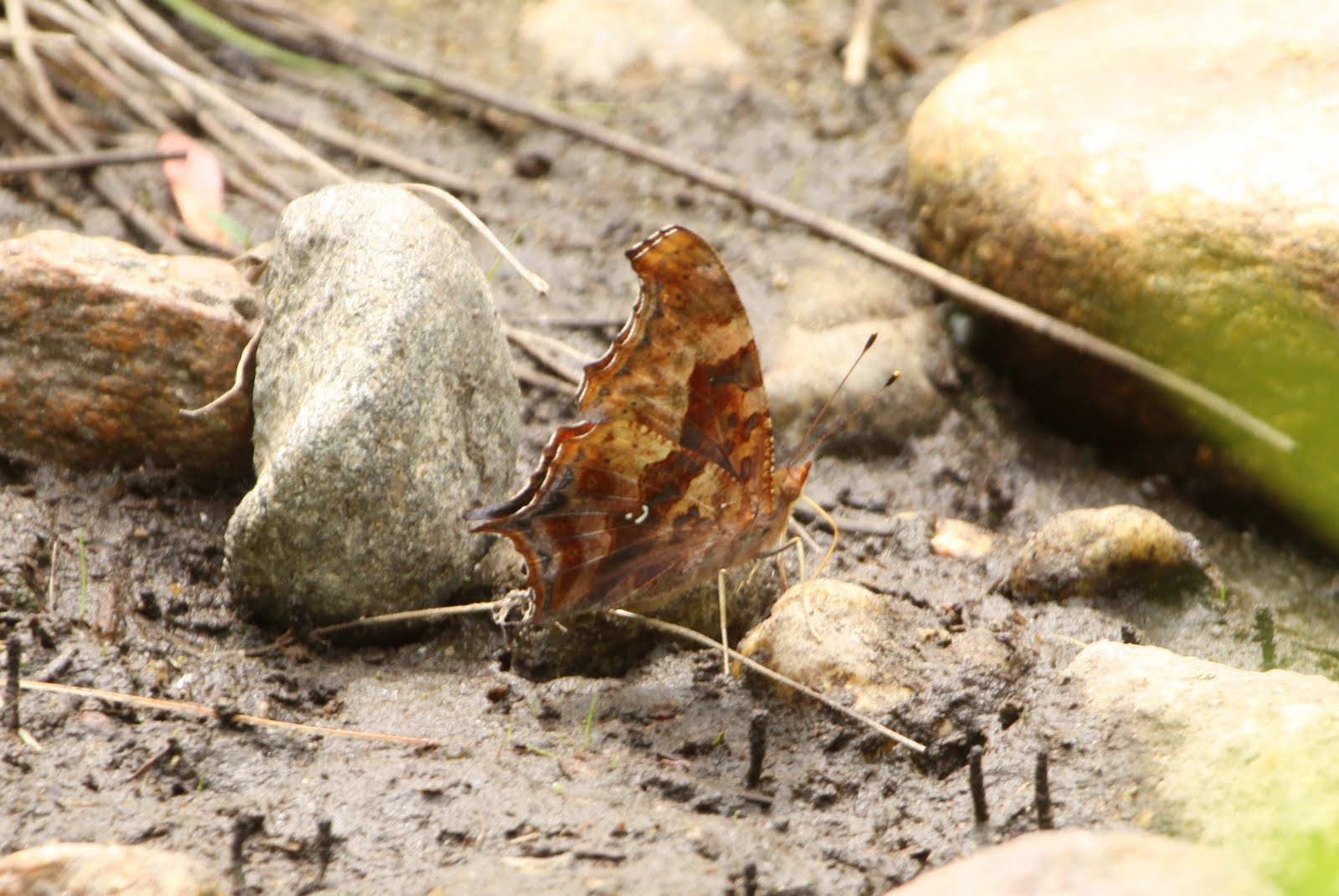
We stopped to photograph a Question Mark.....and from above you could clearly see the black horizontal mark that tells me it's not an Eastern Comma...
and the white marking on the underwing does look like a real question mark.
This area at the end of Gate 35 is always a bonanza for odes. I think this Common Whitetail is an immature male.
We also had several Chalk-front Corporals....
And a number of unidentified odes, including this newly-emerged "teneral".
Not sure about this "green-eyed" fellow either. Or this unidentified one as well. Sometimes odonate identification is exhausting.....
We did have American Bittern calling again from the phragmites island, so we were able to consider this a probably breeding bird for the atlas. As we headed back out we had a nice pair of Common Loons fairly close to our shore....I wondered whether these were the same two as last year that we watched and watched, but never confirmed their breeding.
We also had flyovers again from Westover as we left the water area.....
Back at the powerlines the turtles were going to town with their egg-laying. We had this Painted actually laying her eggs very near the road....
and this Snapping Turtle doing the same.
As I was photographing the turtles, Mark spotted a snake sunning itself further up on the road. He thought it was a Black Racer.
Suddenly he yells to come quick with my camera because it was a Hog-nosed Snake!!! In the 35+ years we have been out birding together, I have never seen this snake.
One of the first things you notice is that it spreads the skin around it's head and tries to look like a Cobra....very cool.
Of course once Mark picked her up she was as docile as our own pet Rosy Boa at home. She didn't even try to bite him. She has that little pug nose (although I suppose it's really a "hog" nose) so she looks kinda cute.
She constantly "tasted" the environment and probably knew she was in no danger. This alone not only made my year at Quabbin, but might have made every trip ever made into Gate 35 worthwhile.

Going over to bird Gate 22 and finish the block for the morning didn't produce anywhere near the excitement...although we did have a female Common Merganser swim out from some bushes right next to the shore where we were standing.....no sign of ducklings though.
As we headed out a different gate I saw these "steps to nowhere" which I had never seen before. I now have to do some research and figure out whose cellar hole they were leading to.
These couple of recent trips to Gate 35 made me realize no matter how many times you go to an area, there can always be surprises and new things to find.

Enjoy.....Sheila