We spent time in Gate 35 covering our Shutesbury 10 block. Birds were not plentiful along the road in, but we hit it when the Pink Ladyslippers were at their best.
  We had a small group of warblers fly in across the Quabbin and this is a picture of a little Black & White Warbler that landed and proceeded to go directly to sleep. We watched him for almost 10 minutes and he didn't move a feather!
  This Hermit Thrush, on the other hand, was very active and out feeding....but not making a sound.
  We took the little side road that goes off towards the campground in the Women's State Forest and when we got to the marsh we were able to watch this American Lady feeding on the ground right in front of us.
  It's nice to be able to get shots of both the upper and lower wings to ensure we've seen all the fieldmarks.
  We also had Painted Turtle at this marsh which had just come out of the pond to lay her eggs.
  As we continued down the road we had this male Scarlet Tanager feeding down on the road. Wouldn't you know my camera would be on the wrong setting one of the only times when I see this bird down low and not hidden by foliage! Most of shots were almost black....this was the best of the bunch.
  We also had some nice Blue Flag growing on the wet roadside.
  And there were a number of Canadian Tiger Swallowtails feeding there...
  ...along with Juvenal's Duskywing...
  ...and this combination Red-spotted x White Admiral, which was an interesting study.
  Back along the "main" road to the end of Gate 35 the wind had picked up a bit and we actually had whitecaps on the water.
  At one point I actually pulled over to photograph the "waves" splashing on the shore...not something you often see here.
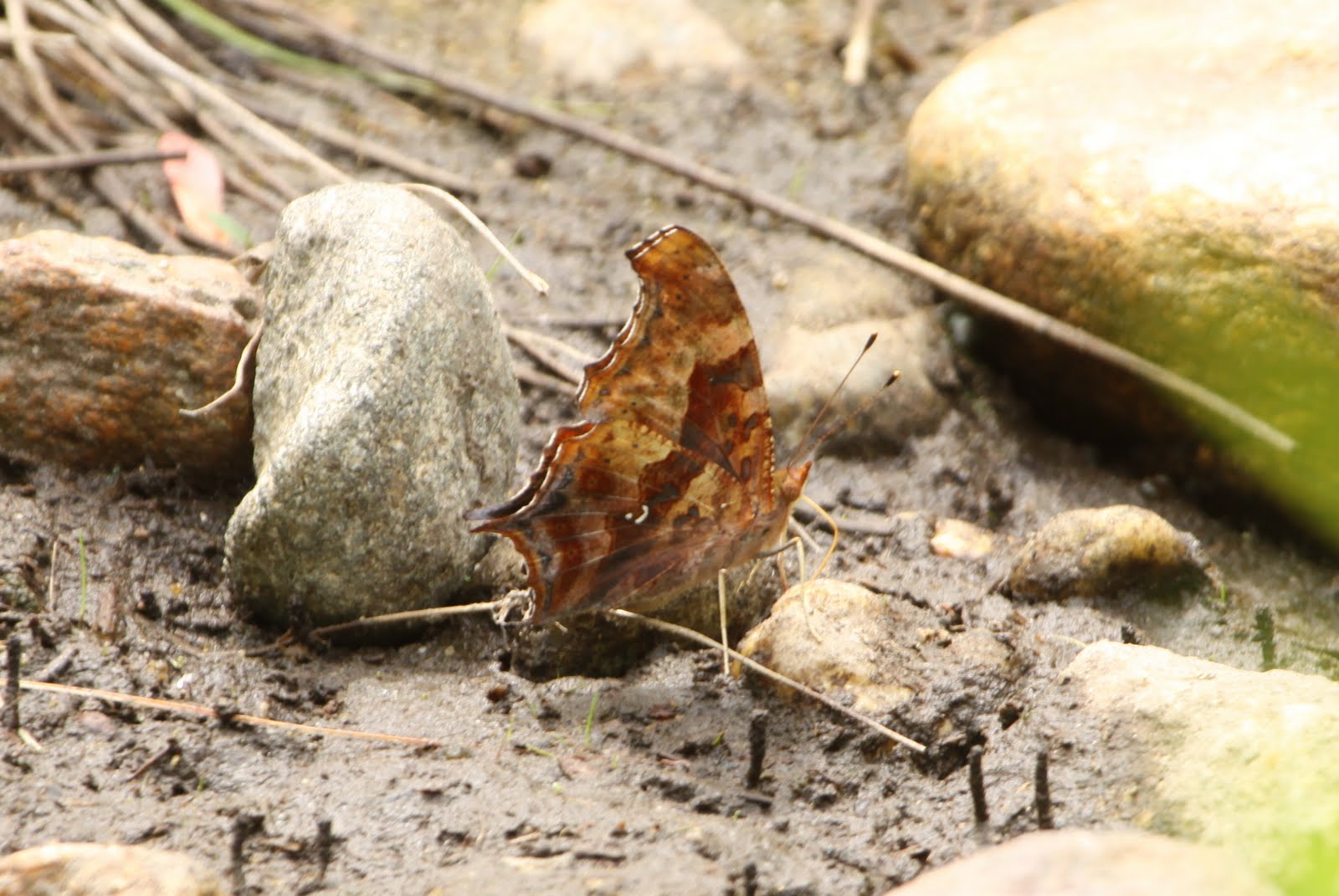
  We stopped to photograph a Question Mark.....and from above you could clearly see the black horizontal mark that tells me it's not an Eastern Comma...
  and the white marking on the underwing does look like a real question mark.
  This area at the end of Gate 35 is always a bonanza for odes. I think this Common Whitetail is an immature male.
  We also had several Chalk-front Corporals....
  And a number of unidentified odes, including this newly-emerged "teneral".
  Not sure about this "green-eyed" fellow either.
 Or this unidentified one as well. Sometimes odonate identification is exhausting.....
  We did have American Bittern calling again from the phragmites island, so we were able to consider this a probably breeding bird for the atlas. As we headed back out we had a nice pair of Common Loons fairly close to our shore....I wondered whether these were the same two as last year that we watched and watched, but never confirmed their breeding.
  We also had flyovers again from Westover as we left the water area.....
  Back at the powerlines the turtles were going to town with their egg-laying. We had this Painted actually laying her eggs very near the road....
  and this Snapping Turtle doing the same.
  As I was photographing the turtles, Mark spotted a snake sunning itself further up on the road. He thought it was a Black Racer.
  Suddenly he yells to come quick with my camera because it was a Hog-nosed Snake!!! In the 35+ years we have been out birding together, I have never seen this snake.
  One of the first things you notice is that it spreads the skin around it's head and tries to look like a Cobra....very cool.
  Of course once Mark picked her up she was as docile as our own pet Rosy Boa at home. She didn't even try to bite him. She has that little pug nose (although I suppose it's really a "hog" nose) so she looks kinda cute.
  She constantly "tasted" the environment and probably knew she was in no danger. This alone not only made my year at Quabbin, but might have made every trip ever made into Gate 35 worthwhile.
Going over to bird Gate 22 and finish the block for the morning didn't produce anywhere near the excitement...although we did have a female Common Merganser swim out from some bushes right next to the shore where we were standing.....no sign of ducklings though.
 As we headed out a different gate I saw these "steps to nowhere" which I had never seen before. I now have to do some research and figure out whose cellar hole they were leading to.
  These couple of recent trips to Gate 35 made me realize no matter how many times you go to an area, there can always be surprises and new things to find.
Enjoy.....Sheila